


Table of Contents
- Why Off-the-Peg Leather Fails When You Need to Move
- What Makes Bespoke Leather Clothing Work for Active Wear
- Choosing Hides and Linings for Custom Leather Performance Wear
- How Made-to-Measure Leather Clothing Gets the Fit Right
- Leather Stage Outfits: Designing for IML, MAL and Club Nights
- Hardware, Finishes and Custom Details That Hold Up
- Caring for Leather Gear Worn Hard and Often
- Commissioning a Bespoke Piece: What to Expect
- Frequently Asked Questions
Last Updated: 19 October 2026
Why Off-the-Peg Leather Fails When You Need to Move
Off-the-peg leather is cut for standing still. That is the problem. A jacket built to look good on a hanger has no allowance for a raised arm, a deep squat, or a shoulder roll, and the moment you ask it to move with you, it fights back.
Bespoke leather clothing for active wear solves this at the pattern stage, not the alteration stage. At Spitfire Leather, we build every piece around the body that will wear it, because no amount of tweaking fixes a pattern cut for someone else.
Here is what most guides get wrong: they treat fit as a sizing issue. It is a geometry issue.
- Standard patterns assume a static torso
- Seams sit where your body bends
- Hides are chosen for looks, not flex
- Hardware is placed for display, not stress
The result is gear that pinches under the arm, rides up at the back, and splits at the seam within a few hard nights. That is not a quality failure. It is a design failure.
What Makes Bespoke Leather Clothing Work for Active Wear
Bespoke leather is clothing cut from a pattern drafted to your own measurements, with panels and seams placed to suit how your body moves. The difference from made-to-measure is subtle but real: made-to-measure adjusts a stock pattern, while bespoke starts from your measurements and builds outward.
Movement comes from three things: pattern, panel placement, and gussets. Get those right and leather stops feeling like armour.
Pattern, Panels and Gussets: Where Movement Comes From
A gusset is an inserted piece of material that adds room exactly where a joint needs it. In leather, that single detail decides whether a garment moves or tears.
Panels follow the direction your body stretches, so the leather flexes along its natural grain rather than against it.
- Crotch gusset: lets you squat and straddle without seam strain
- Underarm gusset: gives full arm raise for stage work
- Articulated knees and elbows: pre-shaped panels that bend with the joint
- Reinforced stress seams: double-stitched where force concentrates
Choosing Hides and Linings for Custom Leather Performance Wear
Hide choice decides how custom leather performance wear feels after two hours of sweat. Thick, stiff hides hold a shape beautifully on a mannequin and turn rigid on a moving body.
| Hide type | Movement | Durability | Best for |
|---|---|---|---|
| Supple full-grain | High | High | Harnesses, trousers, stage pieces |
| Mid-weight cowhide | Medium | Very high | Jackets, club wear |
| Thin lamb | Very high | Medium | Close-fit tops, layered looks |
How Made-to-Measure Leather Clothing Gets the Fit Right
Made-to-measure leather clothing works when the maker measures movement, not just size. We take measurements, because a chest measurement taken at rest tells you nothing about how a garment behaves when you raise your arms.
The process is straightforward:
- Send your measurements or book a fitting
- We draft a pattern around your proportions
- Final garment is hand-assembled
This is why a made-to-measure piece from a specialist beats a generic size chart. The pattern is yours, and it stays on file.
Leather Stage Outfits: Designing for IML, MAL and Club Nights
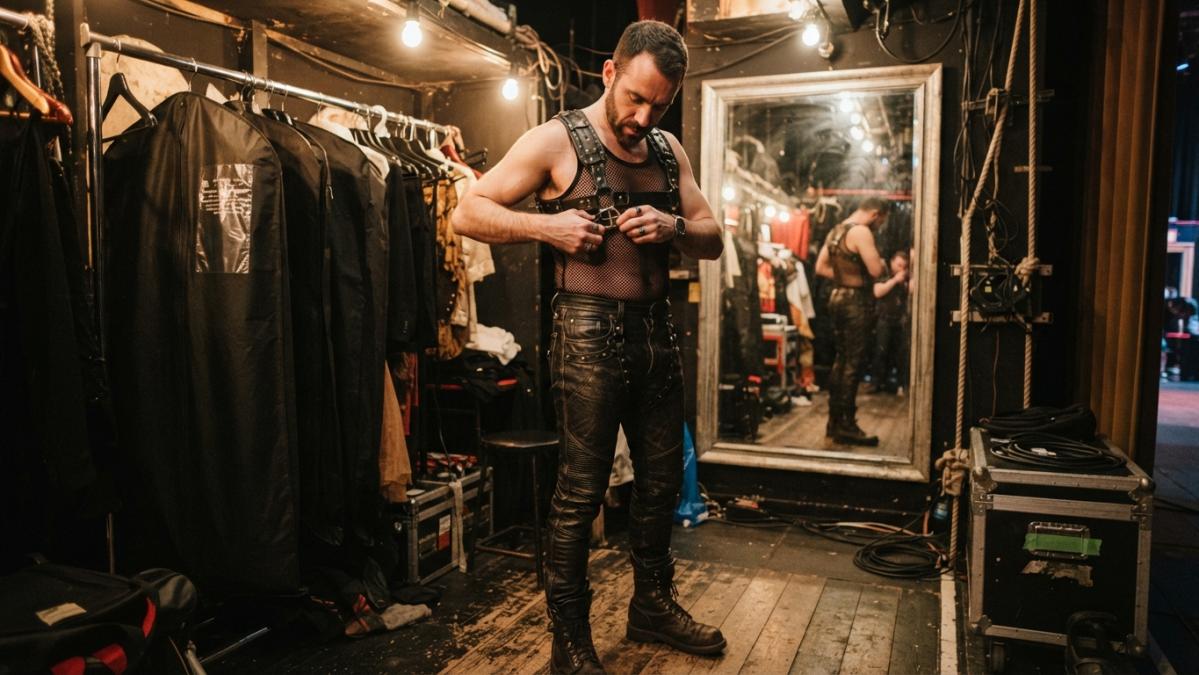
Leather stage outfits have a harder job than everyday gear. They face spotlights, long nights, and constant movement, and they still have to look sharp from every angle.
For events like IML and MAL, we design around three demands: silhouette, security, and stamina. The silhouette has to read clearly from the floor. Every buckle needs to hold under stress. And the piece has to survive a full night without needing adjustment.
That is where limited-edition design earns its keep. Our pieces are worn by fans of BLUF and Tom of Finland, and by contestants at International Mr Leather and Mid Atlantic Leather. Those wearers do not want a standard cut with a logo. They want something nobody else is wearing.
- Reinforced strap anchors for harness work
- Buckles positioned clear of high-flex joints
- Ventilated panels for heat under lights
- Cut to flatter in motion, not just standing
Hardware, Finishes and Custom Details That Hold Up
Hardware is where cheap gear fails first. A decorative buckle that looks solid in a photo can bend, snap, or tear free once it takes real load.
D-rings and buckles are chosen for the force they will carry, then finished to match the piece. Rivets are set through reinforced leather, never through a single thin layer.
Custom details are where a piece becomes yours:
- Buckle finish and metal tone
- Contrast stitching colour
- Panel layout and strap placement
- Lining material and colour
Caring for Leather Gear Worn Hard and Often
Leather worn hard needs care built into your routine, not saved for a crisis. Sweat is the real enemy: it dries leather out and dulls the finish over time.
Commissioning a Bespoke Piece: What to Expect
Commissioning bespoke leather is a conversation, not a checkout. It starts with what you need the piece to do: where you will wear it, how you will move, and what look you want to carry.
From there we agree the hide, the pattern, and the details, then build. Timelines depend on the design and the hide, so we confirm yours before work begins. If you have an event date, tell us at the start.
The limited-edition angle is real. Our collections run in small batches and older designs are retired, so a piece you commission now is not one we will simply run again later.
You do not need to be a scene veteran to commission. If you are new, tell us. We will guide the choices without assuming you already know the language.
Bespoke leather clothing for active wear only works when the pattern, the hide, and the hardware are all built for movement. That is the whole job, and it is the one we do.
At Spitfire Leather, we have been making limited-edition leather couture since 2010, with both off-the-peg and made-to-measure options, each design totally unique and hand-assembled. If you want gear that fits your body and survives the night, start with a bespoke commission and tell us how you move. Get started with Spitfire Leather and own a piece nobody else has.
Frequently Asked Questions
Can leather clothing be comfortable enough for active wear?
Yes, if the garment is cut for movement rather than cut slim for looks alone. The difference comes from the pattern. Hide choice matters too. Bespoke leather lets you match the hide and pattern to the activity, which off-the-peg sizing cannot do.
What is the difference between made-to-measure and off-the-peg leather clothing?
Off-the-peg is cut to a standard size chart, so it fits the average body in the average way and you adjust your expectations around it. Made-to-measure leather clothing is built from your own measurements, so the shoulders, chest, waist and rise sit where they should and the garment moves with your frame. That matters most in areas that are hard to alter later, such as the shoulder line and the seat. Made-to-measure also lets you specify sleeve and leg length without compromise.
How long does a bespoke commission usually take?
Timing depends on the design and the hide, and it is always worth asking before you commit, especially if you have an event date. The realistic sequence is measurements, pattern work, a fitting or fit check, then construction and finishing. Complex pieces with lots of hardware or panel work take longer than a straightforward waistcoat or harness. If you are ordering for IML or MAL, start the conversation well ahead of the date rather than assuming a quick turnaround.
Can bespoke leather garments include custom details and hardware?
Yes. Custom leather performance wear can be specified with the hardware you actually want. You can also choose colour and finish rather than accepting the standard offering. Ask what is possible before the pattern is cut, because hardware placement affects how the garment is constructed. Details added late in the process either cost more or compromise the fit.


