


Table of Contents
- Handmade vs Mass Produced Leather Clothing: The Core Differences
- Side-by-Side Comparison: Handmade and Mass-Produced Leather
- Pros and Cons of Handmade Leather Clothing
- Pros and Cons of Mass-Produced Leather Clothing
- How to Identify Quality Leather Garments Before You Buy
- Bespoke Leather Clothing: When Made-to-Measure Makes Sense
- How to Break In New Leather Trousers Safely
- Choosing Between Handmade and Mass Produced Leather
- Frequently Asked Questions
Last Updated: 12 October 2026
Handmade vs Mass Produced Leather Clothing: The Core Differences
The difference between handmade vs mass produced leather clothing comes down to how the hide is cut, who sews it, and how much of the maker's attention each garment receives. Handmade pieces are cut and assembled by one or two people working on a single garment at a time. Mass-produced pieces move down a line where speed and consistency set the pace.
At Spitfire Leather, we have been making limited-edition leather garments since 2010, so we have watched this divide widen. The two categories look similar in a product photo. They behave very differently after a year of clubbing.
Here is the practical distinction. Handmade leather clothing is cut from individually selected hides, with panels matched for thickness and grain, then assembled by hand. Mass-produced leather clothing is cut in stacks from a template, using hides chosen for uniformity rather than character.
That gap explains why one shirt softens into your shape and another stays stiff, or sags at the shoulder. Below, we break down where each approach wins, where it fails, and how to tell them apart before you spend money.
UK government guidance on textile and leather product labelling
Side-by-Side Comparison: Handmade and Mass-Produced Leather
The table below summarises the differences that matter most to buyers: material selection, construction, fit, lifespan, and how each responds to wear.
| Factor | Handmade Leather | Mass-Produced Leather |
|---|---|---|
| Hide selection | Individually chosen, grain matched | Bulk graded, uniform |
| Cutting | Single garment, by hand | Stacked, from template |
| Seams | Double-stitched, reinforced | Single or glued in places |
| Fit | Adjustable, often bespoke | Fixed standard sizing |
| Break-in | Moulds to the wearer | Stays rigid or creases badly |
| Lifespan | Years with care | Often a season or two |
| Exclusivity | Limited runs, unique pieces | Thousands of identical units |
The row that surprises most people is break-in. A well-made garment is designed to change shape with you. A cheap one has already finished changing before it reaches you.
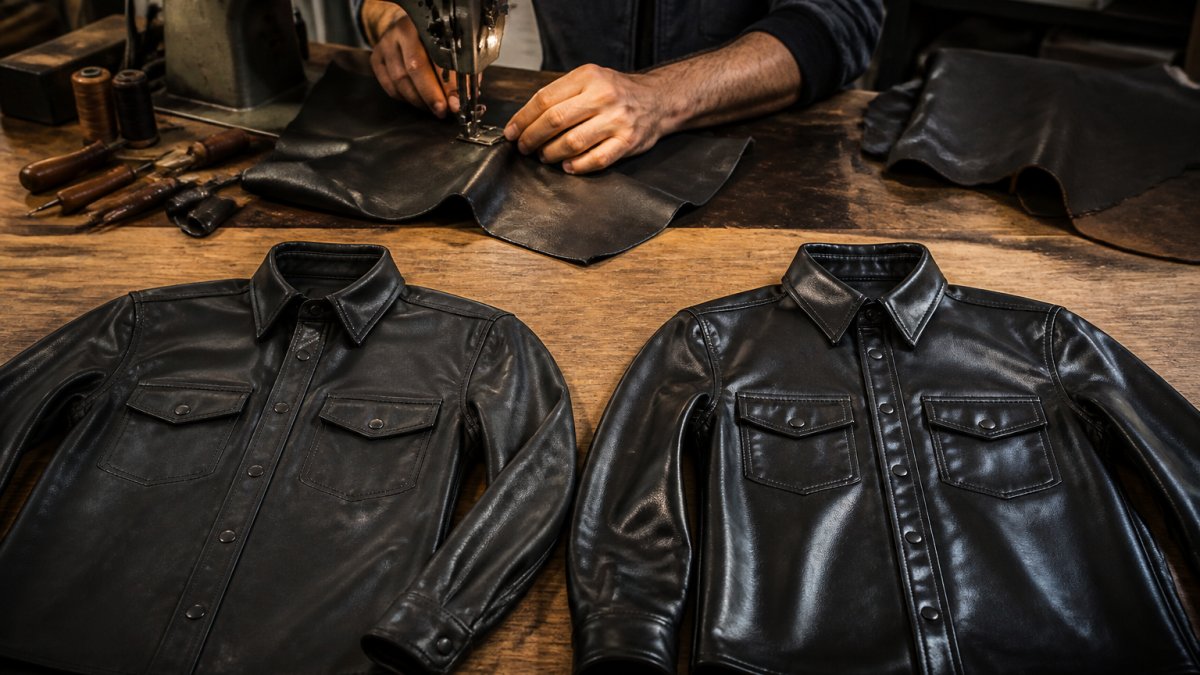
Pros and Cons of Handmade Leather Clothing
Handmade leather clothing wins on longevity, fit, and individuality, but it costs more and takes longer to arrive. That trade-off is the whole story.
Pros:
- Hides are selected individually, so grain and weight match across the garment
- Double-stitched seams hold up to repeated wear and movement
- Garments mould to your body instead of fighting it
- Limited runs mean you are unlikely to meet someone wearing the same piece
- Repairs are usually possible because construction is accessible
Cons:
- Higher upfront cost than a factory equivalent
- Lead times can run weeks for bespoke work
- Fewer sizes on the shelf; you may need to wait for your run
- Slight variations between pieces, which some buyers read as inconsistency
That last point deserves honesty. Variation is the signature of handwork. If you want two identical shirts, you want a factory.
Pros and Cons of Mass-Produced Leather Clothing
Mass-produced leather clothing wins on price, availability, and speed. It loses on fit, durability, and character.
Pros:
- Lower price point, often dramatically so
- Immediate availability in standard sizes
- Consistent sizing across repeat purchases
- Easy returns through large retail channels
Cons:
- Hides are graded in bulk, so panels can vary in thickness within one garment
- Seams are often single-stitched or fused, which is where failures start
- Standard sizing ignores real body variation
- Finishes can crack or peel where the leather was corrected or coated
- Identical pieces are everywhere, so nothing feels personal
A common mistake is judging these garments by the shop photo. Under studio lighting, corrected leather looks almost identical to full-grain. In daylight, six months in, it does not.
How to Identify Quality Leather Garments Before You Buy
Quality leather identification comes down to four checks you can do in under two minutes: look at the grain, read the label, flex the hide, and inspect the seams.
Start with the grain. Full-grain leather shows natural pores, scars, and variation. Corrected leather has been sanded and coated to hide flaws, giving it an unnaturally flat, plastic sheen. Press a thumb into the surface. Good leather creases into fine lines and springs back. Coated leather wrinkles coarsely or not at all.
Then check the label. Terms like "genuine leather" and "bonded leather" describe lower grades, sometimes leather fibres glued together rather than a solid hide. Aniline and full-grain are the markers of better material.
Finally, turn the garment inside out. Look for double-stitched seams, a satin or quilted lining, and clean edge finishing. Loose threads and raw, unsealed edges are the tell.
Our BLUF® NYPD Shirt uses 100% high-grade cow leather with double-stitched seams, press stud fastenings, and a satin-finish lining, which is exactly the construction to look for.
Bespoke Leather Clothing: When Made-to-Measure Makes Sense
Bespoke leather clothing makes sense when standard sizing has already failed you twice, or when you want a piece nobody else owns.
Off-the-peg works for most people most of the time. Made-to-measure earns its place in three situations: you sit between sizes, you need a specific fit for performance or club wear, or you want a one-off design.
The fit problem is real. If you have ordered made-to-measure before and it still pinched, the issue was usually the measurement process, not the concept. Good bespoke work starts with detailed sizing provided by you, not a guess from a size chart. Our NYPD Black uniform is hand-processed from butter-soft leather, with detailing in heavier cowhide, and it is built to order with detailed sizing supplied by the customer.
The exclusivity question is fair too. If a maker re-runs a design, is it still limited? Our answer is straightforward: collections launch every few months and older products are retired. When a run ends, it ends.
How to Break In New Leather Trousers Safely
Breaking in new leather trousers safely means wearing them in short sessions, letting the leather warm and flex naturally, and never forcing the fit with heat or water.
Leather softens through movement and body heat. That process takes time, and rushing it damages the hide. Here is the approach we recommend:
- Wear them indoors for 20 to 30 minutes on the first day
- Walk, sit, and climb stairs to work the knees and seat
- Remove them and let them rest at room temperature
- Repeat daily, adding 15 minutes each session
- Condition lightly once the leather starts to feel dry, not before
Skip the old tricks. Do not soak them. Do not use a hairdryer. Do not stretch them over a chair. Heat and water strip the oils that keep leather supple, and once those are gone, the hide stiffens permanently.
If a pair is genuinely too tight after two weeks of gradual wear, the problem is the cut, not the break-in. A properly sized garment should feel snug, never painful.
Choosing Between Handmade and Mass Produced Leather
Choosing between handmade and mass produced leather clothing is a question of what you want the garment to do. If it needs to last, fit, and feel like yours, go handmade. If it needs to be cheap and available this week, mass-produced will do the job.
Ask yourself three things. How often will you wear it? Does fit matter for how it performs? Do you care whether someone else is wearing the same piece?
Two yes answers point to handmade. Three point to bespoke.
This is where we are honest about our own position. Spitfire Leather makes limited-edition leather couture, off-the-peg and made-to-measure, and we do not pretend to compete on price with factory output. What we offer is a garment cut and assembled with attention, in runs that retire. Our pieces are worn by fans of BLUF and Tom of Finland, Mr Leather national winners, and contestants at International Men of Leather and Mid Atlantic Leather.
If you want something genuinely yours, that is the point.
Frequently Asked Questions
What is the difference between handmade and mass-produced leather clothing?
Handmade leather clothing is cut, stitched and finished by individual makers, often in small runs or to order. Mass-produced garments are cut in bulk from patterns and assembled on production lines. The practical difference shows in seam consistency, leather selection and fit. Handmade pieces typically use full-grain or aniline hides and double-stitched seams, while mass-produced items often use corrected-grain leather and lighter stitching that wears faster under club or performance conditions.
Is handmade leather clothing better quality?
Not automatically, but the odds favour it. A handmade garment lets the maker inspect each hide and align seams with the leather's natural stretch. That matters for fitted pieces like shirts and trousers, where a weak seam fails fast. Mass-produced garments can still be well made, but cost pressure usually means thinner leather, glued edges and less reinforcement at stress points. Check the stitching density, lining and hardware before assuming quality at any price.
How can you tell if a leather garment is handmade?
Look at the seams first. Handmade pieces show even, dense double-stitching with no loose threads or skipped sections. Check the lining, which should sit flat with no puckering. Press the leather: full-grain hides crease naturally and spring back, while corrected-grain feels plastic and stays creased. Also examine the edges, which on handmade garments are usually burnished or folded rather than raw. Small variations between two identical pieces are a good sign, not a flaw.
Is bespoke leather clothing worth the extra cost?
It depends on how you wear it. If you attend events like IML, MAL or BLUF runs and want a piece that fits properly and does not appear on anyone else, bespoke leather clothing earns its cost. Made-to-measure solves the problem of off-the-peg sizing that is tight in the shoulders or loose at the waist. If you wear leather occasionally and fit standard sizes well, an off-the-peg piece from a limited run gives you most of the benefit for less.
How do you break in new leather trousers safely?
Wear them in short sessions at first, an hour or two at a time, so the leather moulds to your movement without over-stretching. Avoid soaking them in water, which stiffens vegetable-tanned hides and can shrink the lining. Apply a leather conditioner sparingly to the knees and seat, the areas that flex most. Never force a zip or press stud on a stiff garment. If a pair feels tight across the thigh after a week of wear, the fit is wrong, not the leather.
Most leather buyers eventually hit the same wall: the piece that looked right in the photo never quite fits, never quite lasts, and never quite feels like yours. Spitfire Leather exists to solve that, with limited-edition runs, hand-assembled construction, and both off-the-peg and bespoke made-to-measure options. Every design is unique, and every collection retires. Get started with Spitfire Leather and own a garment nobody else is wearing.


