


Table of Contents
- How to Measure for a Leather Jacket (and Every Other Bespoke Piece)
- The Leather Jacket Fit Guide: How Tight Should It Really Be?
- How to Measure Sleeve Length for a Leather Jacket (Without Guessing)
- Filling In a Custom Leather Jacket Measurement Form: A Step-by-Step Walkthrough
- Common Measurement Mistakes That Ruin Bespoke Leather Clothing
- Why Bespoke Measurement Matters for Leather (and Not Just Any Tailor)
- Frequently Asked Questions
Last Updated: 18 October 2026
How to Measure for a Leather Jacket (and Every Other Bespoke Piece)
The tape measure is where most bespoke leather orders succeed or fail. Get it wrong and no amount of craftsmanship will save the fit. Learn how to measure for bespoke leather clothing properly and you control the single biggest variable in the whole commission.
Bespoke leather clothing is made-to-measure gear built from your own body measurements, not standard sizing. Leather has almost no give compared with fabric, so accuracy matters far more here than with a cotton shirt.
Below, we'll show you exactly how to take each reading, fill in a measurement form, and avoid the mistakes that ruin fit. But first, here's what most guides get wrong: they treat body and garment measurements as the same thing. They are not.
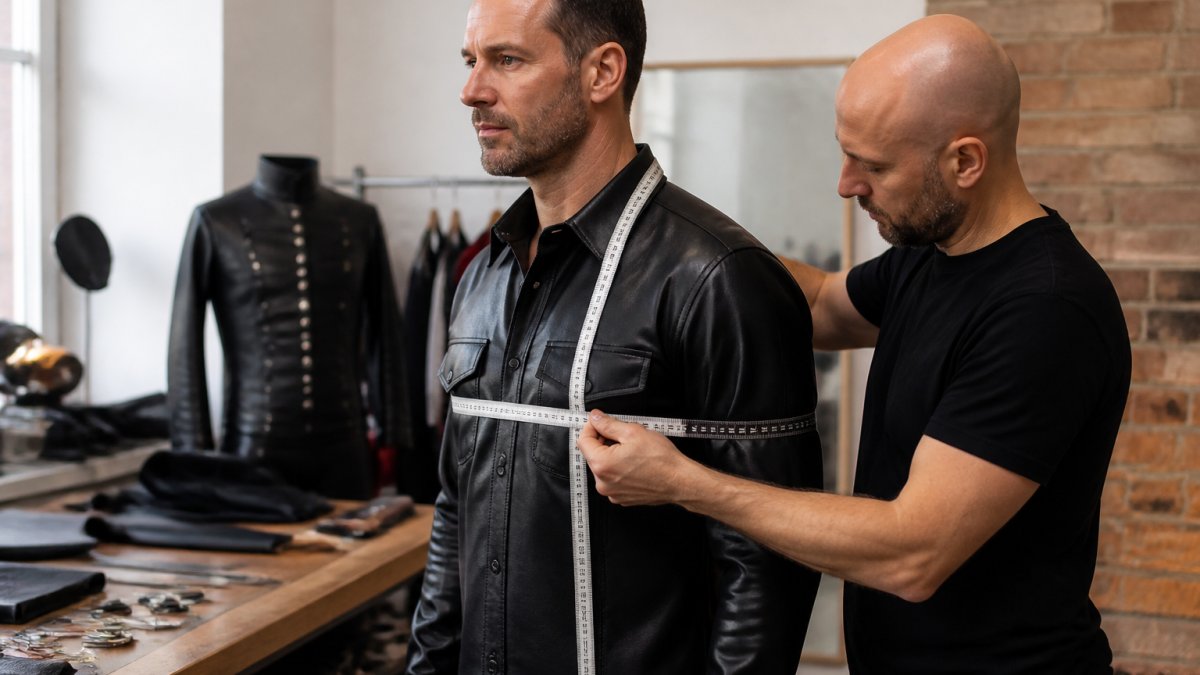
Body Measurements vs Garment Measurements: What Bespoke Makers Need
Body measurements record your actual frame. Garment measurements record the finished piece laid flat. You need both, and mixing them up is a common route to a bad fit.
- Body measurements: taken on you, tape snug but not tight
- Garment measurements: taken on a jacket you already own and love
- Why both: body numbers set the base, garment numbers tell us how you like a piece to sit
The Leather Jacket Fit Guide: How Tight Should It Really Be?
A leather jacket should feel snug across the shoulders and chest, with room to raise your arms and breathe. It should not pull tight across the back when you reach forward.
Leather softens with wear, but it won't stretch like knitwear. Buy for the fit you want on day one, not the fit you hope to grow into.
- Chest: tape sits flat, arms relaxed at your sides
- Shoulders: measure seam to seam across the back
- Waist: keep the tape level, don't suck in
- Length: from the base of the neck to where you want the hem
If you're between sizes, size up.
How to Measure Sleeve Length for a Leather Jacket (Without Guessing)
Sleeve length runs from the shoulder seam to the wrist bone, measured along a slightly bent arm. Keep the arm relaxed and let the tape follow the natural curve.
Two methods work. Use whichever you trust more:
- On the body: start at the shoulder seam, run the tape over a slightly bent elbow, stop at the wrist bone
- On a jacket: lay a well-fitting jacket flat, measure from the shoulder seam to the cuff edge
For a leather jacket, the cuff should sit at the wrist bone, not past the knuckles. Too long and it bunches; too short and it rides up when you reach.
UK government guidance on accurate body measurement for clothing
Filling In a Custom Leather Jacket Measurement Form: A Step-by-Step Walkthrough
A custom leather jacket measurement form is a written record of your body and fit preferences. Fill it in slowly, in centimetres, and double-check every field before you send it.
- Gather your tools: a soft tape measure, a helper, and a mirror
- Wear the right base layer: the shirt you'll wear under the piece
- Stand naturally: feet flat, arms relaxed, don't puff out your chest
- Take each reading twice: if the numbers differ, take a third
- Note your preferences: sleeve length, hem position, how snug you like the waist
- Record in centimetres: one unit throughout, no mixing
- Photograph the form: keep a copy for your records
| Measurement | Where to Measure | Common Error |
|---|---|---|
| Chest | Widest part, tape level | Tape too tight |
| Shoulders | Seam to seam across back | Measuring the front |
| Sleeve | Shoulder seam to wrist bone | Arm held straight |
| Waist | Natural waistline | Pulling the tape in |
| Length | Base of neck to hem | Guessing the hem point |
Common Measurement Mistakes That Ruin Bespoke Leather Clothing
The biggest mistake is measuring alone. A tape that twists at the back or sags at the shoulder gives false numbers, and you won't spot it without a second pair of eyes.
Other frequent errors:
Plain Black BLUF® Shirt (sheep) →
- Measuring over bulky clothing, then wearing the piece over a thin shirt
- Holding the tape loose at the chest but tight at the waist
- Mixing inches and centimetres on one form
- Measuring a jacket that never fitted well in the first place
- Forgetting to note how you like the sleeve and hem to sit
Each one is easy to fix. Slow down, use a helper, and stay consistent with units.
A common mistake is treating a body measurement as a garment measurement. They answer different questions, and swapping them is how a made-to-measure order arrives too tight in the wrong places.
Why Bespoke Measurement Matters for Leather (and Not Just Any Tailor)
Leather is unforgiving. Unlike wool or cotton, it holds its shape and offers little stretch, so a measurement error shows up immediately in the finished piece.
That's why made-to-measure leather needs a leather specialist who understands the material, not just a tailor who works in fabric.
At Spitfire Leather, we've been crafting limited-edition men's leather couture since 2010, offering both off-the-peg and bespoke made-to-measure pieces. Our gear is worn by fans of BLUF and Tom of Finland, by Mr Leather national winners, and by contestants at International Men of Leather and Mid Atlantic Leather.
British Standards Institution guidance on garment sizing and fit
Want a sense of how our pieces are cut? The Plain Black BLUF® Shirt is a fitted, four-panel design in full-grain sheep leather, and the Classic Bluf Jacket shows how a structured biker silhouette should sit across the shoulders.


Frequently Asked Questions
Should I measure my body or a well-fitting jacket?
For bespoke leather clothing, always measure your body first. Measuring an existing jacket can help as a cross-reference, but it won't tell the maker how the piece should sit on you. If you send only garment measurements, you risk copying the flaws of that jacket. Use a soft tape measure against your skin or thin clothing, and note any areas where you prefer a looser or closer fit.
How do I measure sleeve length for a leather jacket?
Start at the shoulder seam (or the bony point of your shoulder if measuring your body) and run the tape down the outside of your arm to where you want the cuff to end, usually just past the wrist bone. Keep your arm relaxed at your side. Leather doesn't stretch, so accuracy here prevents the cuff from riding up when you reach forward.
Can someone else take my measurements for better accuracy?
Yes. Having another person measure you is more reliable than measuring yourself, especially for chest, shoulder width, and back length. Stand naturally and breathe normally while they work. Ask them to keep the tape snug but not tight, and to read the number at eye level. If you're alone, take each measurement twice and use the average. For bespoke leather clothing, a second pair of hands reduces the chance of a twisted tape or a slanted reading.
What should I wear when taking measurements for leather clothing?
Wear thin, close-fitting clothing such as a t-shirt and trousers, or just underwear if you're comfortable. Bulky clothing adds false centimetres and leads to a loose garment. Remove belts, wallets, and anything that alters your silhouette. Stand in front of a mirror to check the tape stays level. Leather is unforgiving, so measuring over thick layers is one of the most common reasons a bespoke piece ends up too big.
Getting the numbers right is the difference between gear you reach for every weekend and a piece that sits unworn. If you're commissioning bespoke leather clothing, take your time with the tape, send us clear figures, and let us handle the rest.
At Spitfire Leather, every bespoke piece is hand-assembled from premium leather, built as a limited-edition design that's genuinely yours. Get started with Spitfire Leather and commission a made-to-measure piece that fits the way it should.


