


Table of Contents
- How to Choose Custom Leather Colours and Finishes
- Types of Leather Finishes Explained
- Aniline vs Pigmented Leather: Which Suits You?
- Reading a Leather Colour Chart Before You Commission
- Matching Colour and Finish to Club and Event Wear
- How to Care for Finished Leather Garments
- Common Mistakes When Ordering Custom Leather Finishes
- Conclusion
- Frequently Asked Questions
Last Updated: 17 October 2026
How to Choose Custom Leather Colours and Finishes
The right custom leather colours and finishes guide starts with two questions: what will the garment do, and how much patina do you want? At Spitfire Leather, we build every piece from full-grain hides, and the finish you pick changes how that hide ages, feels and performs. Get it right and the garment improves with wear. Get it wrong and you own something that looks tired within a season.
Leather finishes are the surface treatments applied to a hide after tanning. They decide shine, colour depth, water resistance and how the leather responds to club lights and sweat.
Here is the short version:
- Hard wear, easy cleaning: pigmented finish
- Depth and character: aniline finish
- Maximum durability: a heavier top coat
- Maximum individuality: a bespoke colour from a swatch
Below, we break down each finish, how to read a colour chart, and the mistakes that cost people money.
Types of Leather Finishes Explained
Leather finish types fall into four main groups, and each behaves differently on a garment you plan to wear hard.
Aniline uses transparent dye with little or no surface coating. The grain shows through, so every piece looks slightly different. It feels soft and breathes well, but it marks more easily.
Semi-aniline adds a light protective coat over aniline dye. You keep most of the depth with better resistance to spills.
Pigmented leather has a coloured coating over the surface. The colour is even, the finish hides scars, and cleaning is simple. It feels firmer than aniline.
Top-coated or protected finishes sit on top of either base. They add water resistance and abrasion protection, which matters for club wear.
| Finish | Look | Durability | Care Level | Best For |
|---|---|---|---|---|
| Aniline | Deep, natural, variable | Moderate | Higher | Statement pieces, soft shirts |
| Semi-aniline | Rich with protection | Good | Medium | Everyday club wear |
| Pigmented | Even, bold, uniform | High | Low | High-wear trousers and harnesses |
| Top-coated | Slight sheen | Highest | Lowest | Heavy rotation, events |
Aniline vs Pigmented Leather: Which Suits You?
Aniline leather is dyed through without a heavy surface coating, so the natural grain stays visible and the hide feels soft. Pigmented leather carries a coloured coating that gives an even tone and a tougher surface. The choice comes down to how you wear the piece.
Pick aniline if you want depth, softness and a garment that develops character. [Our Black Shirt uses 100% aniline full-grain leather](/products/black-shirt) for exactly this reason: it drapes well and softens further with wear.

Pick pigmented if the garment will see sweat, spilled drinks and frequent cleaning. The even colour hides scuffs and wipes down fast.
Reading a Leather Colour Chart Before You Commission
A leather colour chart shows physical swatches, not printed squares, and that distinction matters. Screens distort colour, and dye batches vary slightly between hides. Always judge a shade from a real swatch under daylight.
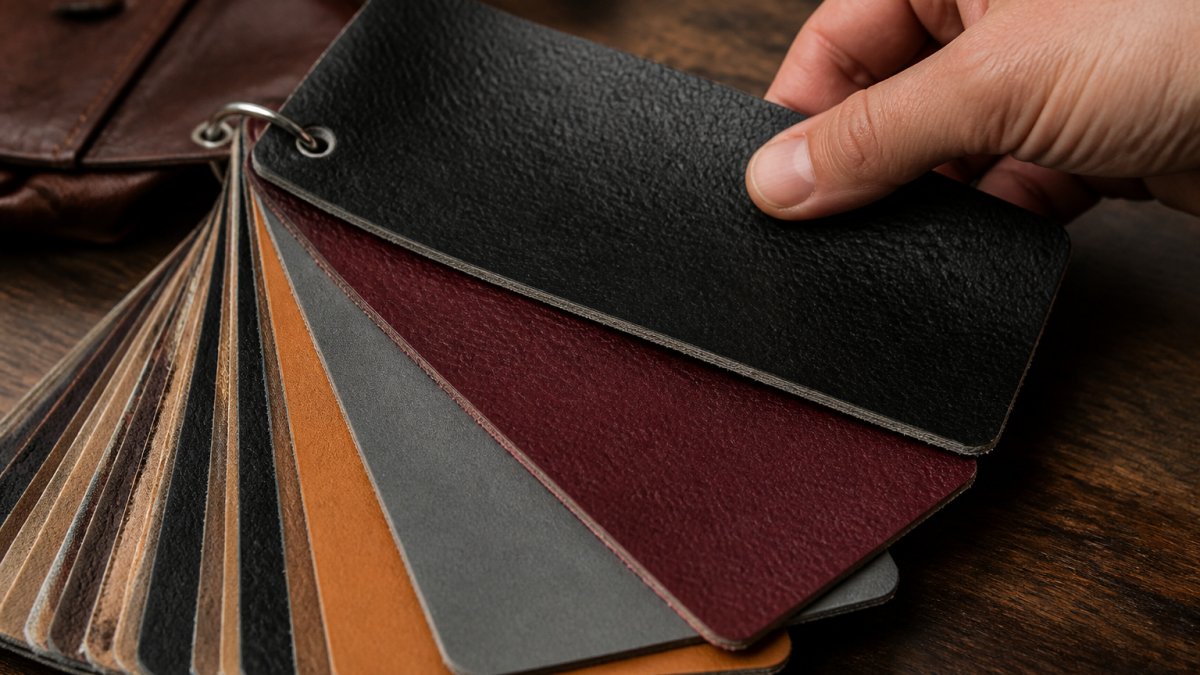
When you read a chart, check four things:
- Undertone: does the shade lean warm, cool or neutral?
- Finish shown: is the swatch aniline, pigmented or coated?
- Grain visibility: how much natural marking shows through?
- Lighting: view it in daylight, not shop spotlights
Ask for the swatch in the exact finish you plan to order. A colour can look completely different once a protective coat goes on top.
Matching Colour and Finish to Club and Event Wear
Event wear puts specific demands on leather: heat, movement, sweat and low lighting. Match the finish to those conditions rather than to a photograph.
For dark club environments, deep shades with a slight sheen catch light and read well on camera. A top-coated finish holds that sheen through a long night. For stage and performance, aniline gives a softer, more natural look under bright lights.
[Our Plain Black BLUF® Shirt (sheep) shows how finish and cut work together](/products/plain-black-bluf-shirt-s): aniline full-grain sheep leather, a satin-lined interior and double-stitched seams for durability across repeated wear.

If you want a lighter tone, our Grey Shirt uses the same aniline full-grain construction, so you get the same softness in a shade that photographs differently under stage lighting.

How to Care for Finished Leather Garments
Caring for finished leather comes down to three habits: keep it dry, clean it gently and store it properly. Most damage comes from neglect, not wear.
- Wipe after wear: a dry cloth removes sweat and surface dust
- Condition sparingly: aniline needs it more than pigmented
- Dry naturally: never use direct heat or a radiator
- Hang, do not fold: folds crease coated finishes
- Store away from sunlight: UV fades dye over time
For aniline pieces, use a conditioner made for unfinished leather. For pigmented and top-coated finishes, a damp cloth is usually enough. Check the Leather Naturally guidance on leather care for material-specific advice before applying any product.
Common Mistakes When Ordering Custom Leather Finishes
The costliest mistakes happen before the order is placed. Here are the ones we see most often.
Choosing colour from a screen. Monitors shift colour. Always confirm against a physical swatch in daylight.
Ignoring the finish behind the colour. Two black hides can behave completely differently if one is aniline and one is pigmented.
Skipping the fit conversation on bespoke. A perfect finish on a badly fitted garment is wasted money. Give accurate measurements and ask how the pattern accounts for movement.
Rushing the timeline. Custom work takes time. Build in a buffer before a fixed event.
Assuming limited editions repeat. Limited runs are exactly that. If a piece matters to you, do not assume it will return.
Conclusion
Custom leather rewards planning. Choose the finish for how you will wear the piece, confirm colour on a real swatch, and give yourself time before the event. The garment then does what good leather should: it improves with every night out.
At Spitfire Leather, we build limited-edition leather couture in small runs, with both off-the-peg and bespoke made-to-measure options. Every design is hand-assembled from full-grain hides, and each piece is made to be genuinely yours. Get started with Spitfire Leather and commission a garment that fits the way you actually wear it.
Frequently Asked Questions
What are the different types of leather finishes?
Aniline (dyed through with no surface coating) shows the natural grain and softens with wear. The right choice depends on whether you want patina and character.
What is the difference between aniline and pigmented leather?
Aniline leather is dyed with transparent colouring so the natural grain stays visible, giving a softer feel and a look that deepens with wear. Pigmented leather has a colour coating applied to the surface, which covers imperfections and handles spills and scuffs more easily. Aniline suits statement pieces worn for events; pigmented leather suits gear that sees heavy club use. Many premium garments, such as Spitfire Leather's aniline full-grain shirts, use the aniline approach for comfort against the skin.
Can leather be dyed a custom colour?
Leather can be dyed to a custom colour, though the starting hide matters: light hides take brighter and more accurate custom shades, while dark hides limit you to deeper tones. Screens distort colour, so a real sample is the only reliable way to confirm a custom shade.
How can I tell whether a leather colour will look the same in person as it does on screen?
You cannot rely on a screen. Monitors shift colour, and aniline leather in particular changes tone depending on the light. If a maker cannot supply a swatch for a bespoke piece, treat the online image as a rough guide only, not a guarantee of the finished colour.


